2nd Mediology Research Network Conference – Call for paper
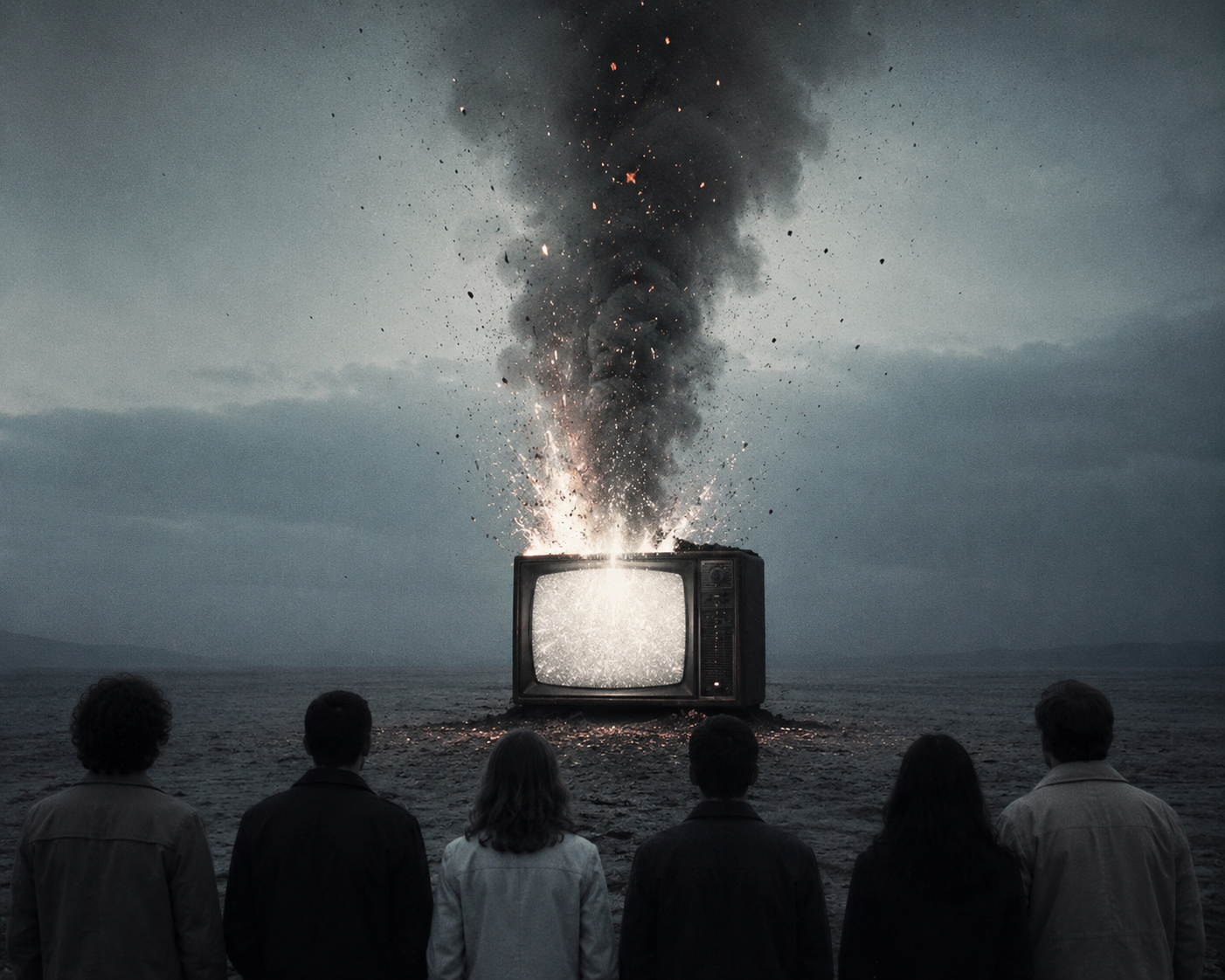
The Spectacle of the End. The End of Spectacle
14-15 December 2026
Call for paper
We are pleased to announce the second MRN 2026 conference, entitled The Spectacle of the End. The End of Spectacle, aims to examine the contemporary transformations of spectacle, media and forms of representation in light of the cultural, technological, political and environmental crises of the present.
The title proposes a twofold perspective. On the one hand, it invites reflection on the spectacle of the end: the forms through which crisis, war, violence, environmental catastrophe, social precarity and imaginaries of collapse and apocalypse are represented, mediated, narrativised and consumed. On the other hand, it calls for reflection on the end of spectacle, understood as the possible transformation or erosion of a central twentieth-century category: spectacle as a form of mass communication, mainstream culture, the culture industry and public visibility.
In this regard, particular attention will be devoted to the non-neutrality of technologies, the role of digital infrastructures in the construction of social experience, the transformation of regimes of visibility and the crisis of twentieth-century mainstream communication. The conference therefore seeks to open a space for reflection on the medial forms of the “end”.
The conference also aims to discuss whether spectacle has simply changed in its devices, languages and audiences, or whether a more radical transformation of its social, cultural and political function is taking place. The spread of digital platforms, generative artificial intelligence, algorithmic environments, personalised communication and fragmented publics appears to be profoundly redefining the forms of representation, attention and participation in media experience.
Thematic sessions
Four sessions are designed to correspond to the twofold structure of the conference. The first two will be devoted to The Spectacle of the End; the second two to The End of Spectacle.
I. The Spectacle of the End
Thematic Session 1 – Imaginaries of the end: crises, catastrophes, apocalypses
This session welcomes contributions devoted to the medial, narrative, aesthetic and symbolic forms through which the end is today represented, narrated and turned into spectacle. Crisis seems to have become one of the major interpretative frameworks of the present: environmental crisis, geopolitical crisis, crisis of democracy, crisis of institutions, crisis of the human, crisis of truth, crisis of the future.
Proposals may address, among other topics:
- representations of catastrophe and collapse;
- apocalyptic and post-apocalyptic narratives;
- climate crisis and environmental imaginaries;
- aesthetics of ruin, survival and destruction;
- representations of vulnerability, precarity and emergency;
- audiovisual, digital and serial forms of catastrophic imaginaries;
- imaginaries of the end in popular cultures, digital media, literature, cinema, video game, seriality and the arts;
Guiding question: How does the end become an object of representation, consumption and spectacularisation?
Thematic Session 2 – War, violence and fear as media experiences
This session focuses on the forms through which war, violence, death, fear and destruction are made visible, shared and consumed within contemporary media environments. The “end” is not only a narrative or symbolic imaginary, but also an everyday presence within information and digital flows.
Proposals may address, among other topics:
- the spectacularisation of war and violence;
- images of suffering, death and destruction;
- the digitalisation of conflicts;
- information, propaganda and disinformation in contexts of crisis;
- aesthetics of fear, trauma and emergency;
- the relationship between visibility, testimony and habituation;
- media representations of humanitarian and geopolitical crises;
Guiding question: What happens when war, violence, death, fear and destruction become ordinary, recurrent and shared media experiences?
II. The End of Spectacle
Thematic Session 3 – The end of the mainstream: publics, platforms, fragmentation
This session seeks to discuss the crisis or transformation of spectacle as a category historically linked to the twentieth century, mass communication, generalist media, the culture industry and the centrality of the mainstream. The question does not concern only the end of individual media or specific cultural forms, but the possible dissolution of a model: spectacle as a relatively centralised system for the production, distribution and consumption of symbolic goods.
Proposals may address, among other topics:
- the crisis of the mainstream and the fragmentation of publics;
- the transformation of television, cinema, radio and generalist media;
- digital platformisation and the reconfiguration of the culture industry;
- connected, participatory, dispersed or algorithmically constructed publics;
- post-mainstream cultures;
- celebrities, influencers, creators and new forms of visibility;
- transformations of the media event and of shared temporality;
Guiding question: Which spectacle has come to an end? Has mainstream spectacle ended, or is the very form of spectacle undergoing a more radical transformation?
Session 4 – After spectacle: technologies, algorithms and new forms of representation
This session is devoted to the redefinition of spectacle within digital, algorithmic and post-medial environments. The end of spectacle does not necessarily imply the disappearance of representation, but rather its dispersion across a plurality of platforms, interfaces, devices, feeds, archives, immersive environments and automated systems. Digital technologies, platforms, algorithms and artificial intelligence cannot be regarded as neutral tools: they contribute to redefining content, forms, publics, cognitive processes, collective imaginaries and regimes of visibility.
Proposals may address, among other topics:
- generative artificial intelligence and cultural production;
- algorithms, personalisation and behavioural prediction;
- platforms and new regimes of visibility;
- automation of communication and creativity;
- digital environments and the transformation of experience;
- datafication, surveillance, profiling and algorithmic governance;
- digital aesthetics and contemporary visual cultures;
- immersive media and extended realities;
- new temporalities of spectacle: live broadcasting, replay, loop, feed, stories, virality;
- hybrid forms between art, communication and technology;
Guiding question: In what forms does spectacle survive, change or disperse today?
Participation format
The conference will take place online on 14 and 15 December 2026, in a format organised over two half-days.
Proposals should envisage oral presentations of no more than 10 minutes. The brevity of the presentation is an integral part of the conference format: each paper should focus on a clearly defined object, research question, case study or theoretical core.
The aim is to encourage agile, focused presentations capable of opening up discussion, while leaving the subsequent written version room to develop the argument more extensively. Selected abstracts may therefore be developed into written contributions for the conference proceedings, with possible publication as Special Issues in scientific journals connected to the network (initially, H-ermes. Journal of Communication and Mediascapes Journal).
Abstract submission
Abstracts must include:
- title of the contribution;
- name, surname, affiliation and contact details of the author(s);
- thematic session of reference;
- abstract (max. 4,000 characters, including spaces);
- short biographical note including role, research interests and any recent publications (max. 500 characters, including spaces);
Abstracts may be submitted in Italian, English, French or Spanish, and must be sent by 30 September 2026 to mediologynetwork@gmail.com.
Acceptance will be communicated by 20 October 2026.
Expected outcome
The conference aims to build an interdisciplinary space for discussion on the transformations of spectacle, media and contemporary cultural forms. The twofold axis The Spectacle of the End / The End of Spectacle seeks to interrogate both the media representations of crisis and the crisis of the categories that have so far enabled us to think communication, the public and the culture industry.